You’re looking to price a roof replacement out for your home. Maybe the insurance company has notified you your homeowners insurance will be cancelled if you don’t replace your 14 year old shingle roof. Maybe you’ve been putting off the leaking ceiling for some time now and you’re finally ready to take action. Or maybe you are just curious if the contractor you’re thinking about working with is over charging you.
Whatever the case may be, it’s important to know what components you should focus on and what may be upsell items that aren’t necessary.
In Brevard county, the chances are you’re looking to replace one of three types of roofs: Asphalt Shingle, Steel/Aluminum, Concrete tile.
Although these are different types of roofs, there are basic components that make a good roofing system. These basic components are a good starting point for determining the price of your roof replacement.
Underlayment (The Silent Hero)
What type of underlayment you decide to have installed does not only affect the price of the roof replacement, but also the effectiveness of your roof’s water shedding capabilities. The important thing to remember is, if you decide to save a few bucks now, it may end up costing you more in the future. There’s three basic types of underlayment you can choose to use when considering a roof replacement. You will have the option to choose from old school tar paper, synthetic underlayment, or a self adhering peel & stick underlayment.
Old School Tar Paper (15 lb & 30 lb Felt) “The water shedder”
For years asphalt-saturated felt paper was the standard roof underlayment used for shingle roofing. Although it is still being used today and does still meet code requirements, most reputable contractors choose to use synthetic underlayment in its place. The cost difference is relatively small and tar paper has certain limitations that make it your worst option for underlayment.
For coastal environments like Brevard County, roofs are regularly exposed to high winds, heavy rain, humidity, and hurricanes. Tar paper can absorb moisture, causing it to prematurely deteriorate over time. It has less of a service life than synthetic underlayment and becomes brittle and ineffective over a shorter period of time.
If you’re looking to replace your roof and you are tight on funds, contact Precision Trades & Services and we will upgrade your underlayment for no extra charge. We want all of our roofs we install in Brevard County to be durable and protected.
Synthetic Underlayment “The water resistor”
Synthetic underlayment has become the preferred choice for most reputable roofing contractors throughout Florida. Similar to the house wrap installed over exterior walls prior to siding installation, synthetic roofing underlayment is going to give your roof increased water shedding ability and a longer service life.
When compared to its predecessor, synthetic underlayment offers a few important advantages to consider.
For installation purposes, synthetic underlayment has superior tear resistance. It’s much stronger than tar paper and is less likely to tear during installation. This ensures a more reliable secondary water resistant barrier beneath the roofing materials. It also offers much better walkability during the installation. Most synthetic underlayments feature textured walking surfaces, making it safer when installing the shingles and reducing the likelihood of accidents or damage during installation.
For water-shedding capabilities, synthetic underlayment does not absorb water. Unlike tar paper, a properly installed synthetic underlayment system will shed water for the service life of the shingles laid over it.
The service life of synthetic underlayment far exceeds that of tar paper. In some studies, synthetic underlayment has been proven to not start deteriorating for up to 60 years. Although your shingles wouldn’t last that long anyway, it can be comforting to know you have that kind of durability over your head.
For roofing projects that get delayed or for whatever reason have to leave the underlayment exposed for a period of time before installing the shingles, synthetic underlayment is not going to deteriorate for 60+ days in most cases when exposed to sunlight. Felt paper will degrade much quicker when exposed to sunlight, compromising your roof even before the shingles are installed in these situations.
Self-Adhered Peel & Stick Underlayment “The water stopper”
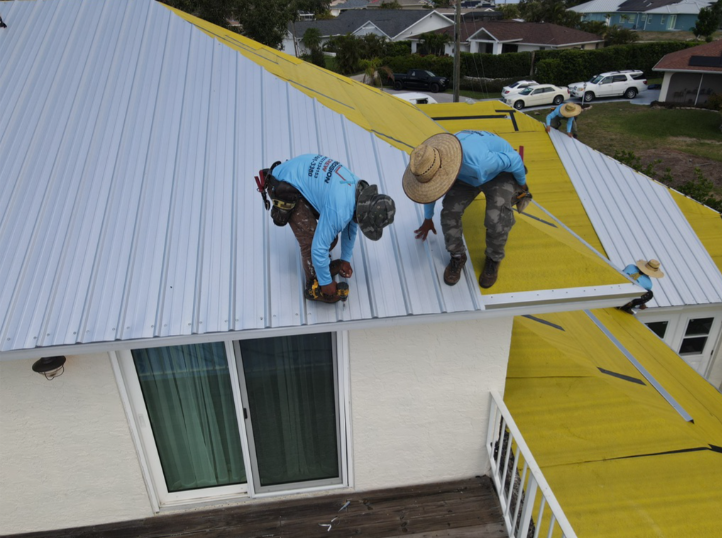
Now we get to the real hero. If you are looking for the highest level of water protection and longevity, Self-adhered peel & stick underlayment is the way to go. Although this is an optional underlayment choice for shingle roofing in Brevard County, when considering a metal or tile roof installation, this type of underlayment is the standard and required in most cases.
For shingle roofing, a self adhered peel & stick underlayment can give you the peace of mind that even if your shingles were to blow off in a hurricane, you will still have a secondary water barrier that is going to protect your home. Even in the event of shingles being blown off, I’ve seen peel & stick underlayment still keep the water from getting inside the house.
Although you will pay more for self adhered peel & stick underlayment, the benefits you will receive will far outweigh the extra investment. Choosing this type of underlayment will also, in most cases, give you a discount on your homeowners insurance premiums. This discount is labeled SWR (Secondary Water Resistant Barrier) on a wind mitigation report and when turned into your insurance company, will typically save you a few hundred dollars a year on your premium.
What makes peel & stick underlayment stand out when it comes to protecting your home from water intrusion? With this membrane applied over your roof deck, your roof becomes more of an impenetrable surface from the harsh Florida elements.
This type of underlayment creates a watertight membrane directly bonded to the roof deck. Every nail and fastener placed in the roof is self-sealed by this membrane, creating a solid impenetrable sheet of protection under your shingles, metal, or tile roofing material.
Should you have a low-slope roof or section of your roof, this type of underlayment is required by code because it provides the highest level of water protection you can get.
Although all of Brevard county is considered a hurricane-prone area, the coastal areas like Satellite Beach, Indialantic, Melbourne Beach, and Cocoa beach are key areas where peel & stick underlayment is a key component you should consider when re-roofing. This is going to be your best option, especially in the coastal regions and budgeting this expense into a new roof is highly recommended.
Code Upgrades
Another thing to consider when budgeting for a new roof is how long it has been since your current roof was installed. The building codes have changed over the years, so if your current roof is twenty years old, you can expect to have to pay for some code upgrades that are required for the re-roofing in Brevard County. The most common code upgrade is the re-nailing of the roof decking. Back in 2005, the code had changed for the type of nail holding your plywood to the rafters/structure of the house. So if your last roof was installed prior to 2005, you can assume you will need to budget for the extra $1000-$1500 that will be charged to re-nail the whole roof decking system.
It’s important to work with a trusted contractor so you aren’t paying for something you don’t need. Your roofing contractor should pull a few nails from different areas of the roof to confirm whether or not you need your roof deck re-nailed.
Checking the roof deck nails is also something inspectors are going to watch for when conducting required county/city inspections during the re-roof process. It’s important to know though, not all county/city inspections are in person and in certain jurisdictions the contractor simply provides a notarized confirmation that the nails were checked and brought up to code if needed. This does leave the opportunity open for a roofing contractor to cut corners and skip the re-nail in order to save a few hundred dollars on labor and material.
This is not typically a major factor in the price of a roof, but it is an extra expense to consider since some contractors may charge more than they need to or may even charge you for a service your roof didn’t really need.
Roof Size/Pitch/Complexity
This is one of the key factors in determining the price of your roof. Obviously the larger the roof, the more labor, materials and disposal and time required. There are three things to consider in the type of roof you have that could impact your pricing.
Roof Size is fairly self explanatory. The larger the roof, the higher the bill. Roofers measure roofs in “squares”. One roofing square equals 100 square feet of roof area.
So if you have a 20 square roof, your roof area is 2000 square feet. This is not to be confused with the square footage of the living space of your home. You could have a 1500 square foot living space in your home but your roof could be 25 squares or 2500 square feet.
Roof Pitch (Steepness) is a big one that most homeowners don’t think about. Roof pitch is measured by how many inches the roof rises vertically for every 12 inches of horizontal distance. Perhaps that doesn’t make sense without further explanation, but to give a few examples for better understanding:
-0/12 Pitch is a flat surface and typically requires the peel & stick membrane discussed previously
-4/12 Pitch is a low slope pitch that is easy to walk on.
-6/12 Pitch is your average residential roof and falls under standard pricing
-8/12 pitch is fairly steep and requires additional safety equipment/precautions
-10/12+ Pitch is very steep and will come with increased labor costs
Roof Complexity will increase not only the labor pricing but also the material pricing. With a more complex roof, you will be looking at fairly significant additional charges to have the roof installed properly. I’ve listed below some of the factors that affect the price of your roof.
-Simple gable roof vs hip roofs
-Number of valleys & hips
-Dormers & chimneys
-Skylights/Sun Tunnels
-Multiple roof levels & wall lines
All of these items listed impact the price of the roof. If your roof is more complex and you have multiple items from the list above, you can expect to pay additional costs for each individual item.
Roof Material
Obviously the type of roofing material you choose to have placed on your roof is going to affect the final cost. Asphalt shingles are going to be your base starting point in pricing out of the three basic roofing types you will likely be choosing from.
Although there are different levels of quality when you are deciding on which manufactured shingle to go with, the main manufacturers you see companies using in Brevard County are similarly priced and similarly matched in quality. The three asphalt shingle manufacturers I would recommend considering for your Florida home are Owens Corning, Certainteed, and GAF.
There are also different levels/families of shingles within these manufacturers that will be your best bet when making your decision.
You should find what fits your aesthetic needs in the following: Owens Corning Duration Series/Certainteed Landmark, and GAF Timberline HDZ. All three of these shingle lines will give you basically the same price point as well as quality.
As far as pricing goes for asphalt shingles in Brevard County, you can expect to pay between $450/square and $550/square generally speaking. Of course all the factors discussed are going to affect the final price, but this would be your cheapest option when preparing for a re-roof.
When it comes to metal roofing, there are more metal manufacturers being utilized in Florida than I care to mention, but you can expect to pay up to double the price of a shingle roof when choosing to upgrade to a metal roof.
On an average home in Brevard County where you may pay $18,000 for a shingle roof, you can expect to pay between $26,000-$36,000 for a new metal roof. Of course the cost is going to be determined based on what profile, gauge, and color you choose but this should give you a general idea of the increased expense for a metal roof.
For metal roof installation in Brevard County, one would expect to pay between $650/square and $1500/square. There is a large gap in the pricing due to the many options you have when choosing to go with metal.
The thickness of the metal you choose will significantly impact the cost of the metal panels. Typically you will choose from two different metal gauges/thickness for a steel roof panel. The typical gauge for aluminum roofs installed in the coastal areas of Brevard County is .032. This is standard and although you can get a thicker gauge aluminum roof, for residential installations, .032 is what the majority of homeowners are going with.
The steel gauges you have to choose from for a residential installation are typically going to be .26 gauge or .24 gauge, with .24 gauge being the thicker of the two. IF you can afford the upgrade to .24 gauge I would recommend doing it as the thicker gauge metal is going to protect your home better in a hurricane situation. The thicker gauge will also withstand hail and other harsh Florida weather better than the thinner .26 gauge.
IF you can’t afford the upgrade, go with the .26 gauge and make sure you have homeowners insurance to protect your investment. Should you ever have claimable damage from a storm or hurricane, then you could potentially make the upgrade utilizing your insurance funds to help close the price gap.
Panel profile is also going to greatly impact the price of your metal roof. If you are looking for the best budget-friendly option, you are going to want to look at an exposed fastener ribbed panel system.
Exposed fasteners systems are going to be the least expensive, however, their durability in this Florida climate is going to decrease the lifespan of this system to the point that some insurance companies are forcing homeowners to conduct expensive maintenance at 10-15 years. This expensive maintenance is replacing all of the screws/fasteners on the roof and is typically costing homeowners a few thousand dollars and in some cases a whole new roof. You can typically plan to spend between $650/square and $800/square for an exposed fastener system here in Brevard.
Hidden fastener/standing seam metal roofing systems are going to be your best functional option for a Florida home, but the price increase is significant as compared to the exposed fastener systems. Standing seam roofing systems are typically going for $750/square and $1000/square for your basic mill or standard colored panels.
Aluminum metal roof hidden fastener panels are what you will likely find within 1500 feet of brackish water. These systems are typically being priced between $1000/square and $1500/square.
Metal roof panel paint/finish is yet another factor that can increase or decrease the price of a metal roof in Brevard County, FL. You can choose to go with the lowest possible option of a Mill/Galvalume finish if you are looking for a pocket friendly metal roof.
If you are looking to protect your investment and have a painted finish on your metal roof, you can expect to pay up to roughly $2500 extra for a standard/SMP colored finish and an extra $5,000 extra if you upgrade to a Kynar/PVDF colored finish.
If you are looking to protect your investment even further, you can choose a Metallic colored finish on the panels which could get you to be paying an extra $5,000-$8,000 on an average size roof here in Brevard.
Panel Relief, although not a significant topic as far as pricing goes, should be considered when making your decisions on what metal roof panel to go with. Please check out other blogs/literature on panel relief when it comes to metal roofing.
You will want to research Oil-Canning and see why panel relief is so important. Oil-Canning is a natural phenomenon with metal roof panels and there could be significant aesthetic repercussions should you choose not to decide on some type of panel relief.
The price ranges for metal roofing are affected by several factors as you may have realized by now so it’s hard to really zero in what your metal roof would cost without touching upon all of these topics. At Precision Trades & Services, we work with you at your own pace to ensure you have all the information you need before moving forward with an investment like a metal roof.
As far as a concrete tile roof goes, you can expect to pay more than double what it would cost to have asphalt shingles installed and typically slightly more than a higher end metal roof. There are basically three main manufacturers you will see being installed in Brevard County: Eagle/Boral/Crown. All three manufacturers offer different families/lines of product. With a concrete tile roof, you can expect to pay between $1200/square and $1800/square.
There has been an increased trend for synthetic tiles here in Brevard as well as metal roof tiles. These tiles mimic the concrete tile look and typically cost slightly less than the concrete tile installation.
Without going into too much detail on this topic, it’s important to find the right contractor to work with to help guide you through all of your options. At Precision Trades & Services, we strive to build great relationships with our clients and believe communication is one of our strong points.
Ventilation
A properly ventilated roof is likely the most important piece of the puzzle when it comes to shingle lifespan. It’s also very important not to get this wrong or you risk mold/mildew issues inside the home and attic due to the harsh Florida weather.
Don’t assume your house was built with proper ventilation. Most general contractors are looking for places they can cut costs to fatten their pockets when building communities. Unfortunately I see it too often where homes are not properly ventilated and a roofing company doesn’t diagnose the ventilation for the home and ensure maximum potential airflow is attained. Although the type of ventilation you or your contractor chose to go with isn’t going to break your bank, it will have a significant impact on how long your investment will last.
With ventilation, it’s important to know your options. There have been many advancements in the understanding of ventilation over the last decade. If your contractor is not aware of the different types of ventilation and what would work best on your home, it may be time to get some other opinions.
Your best passive ventilation option is going to be vented soffit and ridge vents. Where many contractors/homeowners fail with this type of ventilation is in the attic. It’s important to ensure your airflow is not hindered by insulation or other items in the attic that could be blocking the airflow. With vented soffits and ridge vent, you can expect the air in your attic to be replaced 1-2 times an hour depending on the elements outside. If there’s no wind, there’s little to no airflow in your attic.
Your second option, but also a top option if installed properly is going to be forced ventilation by way of solar attic fans. With solar attic fan(s) installed properly on your roof, you can expect the air to be replaced in your attic 6-8 times per hour. This will decrease your overall attic temperature and the benefits are two-fold. Your roof deck is going to maintain a lower temperature, increasing the lifespan of your roofing material, and your attic space is going to likely be 15-20 degrees cooler. With a cooler attic space and proper insulation in the attic, you can expect your cooling bill to be less than what it would be without.
Some homes are set up with only gable venting, which is certainly going to decrease the lifespan of certain roofing products as well as cost you more in cooling the inside of your home. If you have gable venting and you are looking to upgrade or replace your roof, I would suggest upgrading your ventilation as well.
At Precision Trades & Services, we offer several options for solar attic fans. Our most popular option is a 40Watt iSolar Solar attic fan. This fan comes with a 20 year warranty and will cost you roughly $700-$1100 for the fan plus installation depending on the layout of your roof.
Flashings
Flashing replacement typically becomes a factor that pops up during a re roof. This is sometimes a surprise cost that cannot always be determined until the current roofing material is removed. Anywhere a wall meets the roofline you should have flashing. Typically this flashing will galvanized steel, unless you are beachside or not to brackish water. In those cases the wall flashings are typically Aluminum. Copper and lead are also used in some cases for roof-to-wall flashing.
During a re roof, you should keep some budgeting in mind for wall flashing replacements. Make sure you ask for pictures from your contractor if they are recommending replacement AND why they feel it needs replaced. If the wall flashing is compromised, there shouldn’t be any reason why your contractor can’t show you why it needs to be replaced.
If wall flashings do need to be replaced, you can assume an extra $1000-$2000 in most cases. If you are being asked to pay more than that, I would imagine you already know this is the case because you would likely already have had evidence of leaks on the inside ceilings/walls.
In Brevard County, if you are needing wall flashings replaced, you have to assume there will be costs to manipulate the wall as well in order to properly install the flashing.
If you have stucco, the stucco will need to be cut out and then reinstalled and painted after the fact. If you have Hardie or Vinyl siding, this will have to be detached and reset, which will come with a price tag as well. Every contractor is going to be different in how they handle flashing replacements. Many roofing contractors in Brevard County will replace the flashing but leave it up to you to find a stucco installer and painter to finish the job.
Here at Precision Trades & Services, we are able to handle all aspects of your roof replacement and will put things back the way we found them or better. Our installers are skilled craftsmen and we take pride in being able to offer you more than just roofing.
Skylights/Sun Tunnels
This is one aspect of a roofing quote that can make the price per square move upwards quickly. I don’t recommend recommissioning an old skylight with a new roof. Doing so will almost always set the stage for out of pocket expenses in the future. Most roofing contractors are not going to warranty the area around an old skylight on a new roof.
Your average skylight sizes in Brevard County are your 2’x2’ and 2’x4’ fixed or venting skylights. On average you can expect to spend an additional $700-$1400 per skylight. The problem with calculating skylight pricing lies with the fact that there are several manufacturers and skylight options to choose from.
If you are looking for more light in certain areas of the home, sun tunnels are a great option. They even offer a “nightlight” option that gives off a subtle glow at night time. This is good for bathrooms and kitchens so you don’t have to turn on lights when you’re up for your midnight snack or bathroom run.
Permits/Inspections
Permit fees are typically included in your roofing quotes. You can actually estimate your permit fees with the following formula, for Brevard County Residents:
$25 Application fee + $10 Enforcement fee + $75 for the first $1,000 of job value, plus $3.25 per additional $1,000 of job value. There are also some small state surcharges.
You can assume a $125-$200 budget for county jobs and a $250 budget for a city residential roof permit fee.
Some municipalities have their own fee schedule. If you live in Melbourne, Melbourne Beach, West Melbourne, Indialantic, Palm Bay, Rockledge, Cocoa, or Titusville, you can assume a budget of $250-$500 to be safe.
Warranty Considerations
A solid warranty can give you peace of mind, but will the manufacturer back it when the time comes? Not only that, will your contractor still be around to warrant their work should the time come?
These are great questions that don’t always have immediate answers. At Precision Trades & Services we only work with manufacturers that have good reputations for backing their product. We hold contractor status with all of our manufacturers to ensure you not only have our backing, but the manufacturers back our work as well.
Warranty upgrades are always available and if you have the extra budget, they can be a great investment that’s worth its weight in gold in the event of a manufacturer or craftsman issue.
If you want to budget for an upgraded warranty, I would suggest putting aside $500-$1000 for the best upgrades you will be offered.
Most standard warranties are still great warranties with the manufacturers we work with, so don’t feel bad if you can’t work a warranty upgrade into your budget.
At Precision Trades & Services, we offer craftsmanship warranties from 2-10 years depending on the project and material chosen. You can always count on us being there for you should a warranty issue present itself.
Hurricane Protection Upgrades (retrofit clips)
If you are looking to upgrade your home’s hurricane protection, completing the upgrade during a roof replacement is going to save you money and your contractor some hassle. If you haven’t had a wind mitigation completed on your home to determine your level of protection, I would recommend doing so prior to and after your re roof process.
Precision Trades & Services offers a free certified wind mitigation report with every roof we complete. For around $150, you can receive a wind mitigation from a licensed home inspector in the state of Florida. Doing so will give you the information needed to make a decision whether or not you should upgrade your protection.
Most insurance companies will include premium discounts for a home that meets or exceeds certain standards for hurricane protection/preparedness. Typically the main upgrade homeowners are performing in Brevard County is ensuring there are proper roof-to-wall attachments. These attachments come in the form of hurricane straps/clips.
If you are upgrading your roof-to-wall attachments during the re-roof process, your contractor will remove a three to four foot section around the perimeter of the eaves of your roof to expose the area needing serviced. If you have this completed after the re-roof process, the contractor is forced to go through the soffit area to secure the attachments. This will cost you more due to the additional labor it takes to be able to access the roof-to-wall line through the soffit.
At Precision Trades & Services, we utilized approved hurricane clips for our roof-to-wall attachment upgrades. Most of our customers that choose this option are also recipients of the MySafe Florida Home Grant provided by the state. It’s a great program that offers up to $10,000 to Florida homeowners to improve your home’s hurricane rating. Precision Trades & Services was one of the original contractors of the program when it was revived/re-established in 2022. If you’re not sure if you qualify or what the program offers, please go to the MySafe Florida website for more information. Chances are your home qualifies and the funds can be utilized for more than just upgrading your roof. You also receive a FREE wind mitigation report when you start the program.
If you aren’t utilizing MySafe Florida funding for your hurricane protection upgrade, you can expect to pay between $3,000-$6,000 on the average Brevard County home depending on the layout of your roofing system.
Fascia/Gutters
If you have any fascia rot or the old Peg & Ferrule or spike and ferrule gutters, the time to fix your fascia boards and upgrade your gutters is during the re-roof process. Sometimes face board rot is not always prevalent until the shingles come off. This can lead to unexpected expenses and will need to be replaced in order for your roof and drip edge to be installed correctly.
If you have the outdated gutters being held up by spikes, I would consider upgrading to 6” Aluminum Seamless Hidden Hanger Gutters to combat the torrential rain here in Florida. These systems come with 3”x4” downspouts and will compliment your new roof for sure.
If you have face boards that need to be replaced, you can assume you’re going to be paying anywhere from $10/linear foot to $20/linear foot by most reputable contractors. Of course the price will depend on several factors including material type and accessibility.
For new gutter installation, you can assume you will pay anywhere from $8/lf to $14/lf depending on system requirements and accessibility. Most average homes in Brevard County are typically between $2500-$4000 for a new gutter and downspout system.
Closing Remarks
As you can see, there are many factors that can affect the price of a roofing project. The cheapest estimate is not always the best value, as you may now realize. The most expensive estimate may not always be the highest quality either. When deciding to replace your roof, don’t be afraid to ask questions. A reputable contractor should be able to explain their recommendations and provide documentation when needed.
At Precision Trades & Services, we believe homeowners deserve honest answers, transparent pricing, and quality craftsmanship. We treat every project as if we are working on our own homes. We have the same goals in mind as you should when it comes to replacing your roof: Protect your family, Improve your home’s value and give you peace of mind during the harsh Florida weather conditions.
Typical Roof Replacement Cost by Roof Type in Brevard County:
Roof Type General Cost per Square
- Asphalt Shingle $450-$600
- Exposed Fastener Metal $650-$800
- Standing Seam Metal $750-$1200
- Standing Seam Aluminum $1000-$1600
- Concrete Tile. $1200-$1800